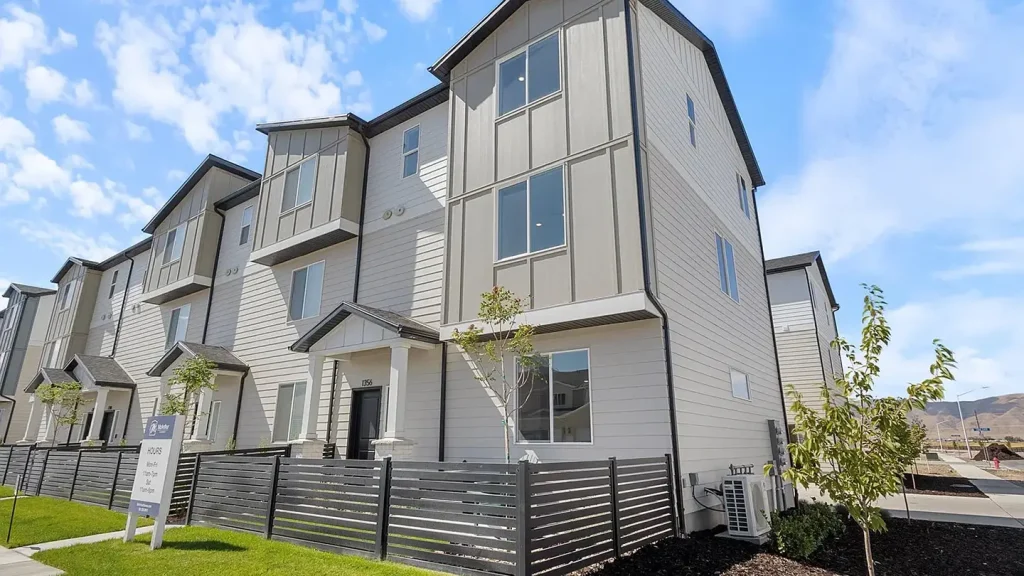
What you need to know now about building a house in Utah:
- The average new home in the Mountain region, which includes Utah, took 9.1 months from permit to completion in 2025, while a quick move-in home can close in 30 to 90 days.
- Your actual timeline depends more on which type of build you choose than on anything else: spec, production-community, or fully custom.
- Permits, finish-level decisions, and subcontractor scheduling are the three biggest swing factors once your lot is ready and your loan is lined up.
- A construction loan needs to be approved before groundbreaking, not during it, or your “start date” slips before the first shovel hits dirt.
Keep reading for a stage-by-stage breakdown, the real factors that add weeks to a Utah build, and how to line up financing so your move-in date holds.
How Long Does It Take To Build a House in Utah Right Now?
As of the most recent 2025 data, homes in the Mountain census division, which covers Utah, averaged 9.1 months from the day a permit is issued to the day construction wraps. That’s close to the national average of 8.8 months, but the number swings hard depending on what you’re building and where you’re building it.
Think of a home build less like one long project and more like three relay legs handed off between different teams: design and approvals, structural construction, and interior finishing. Each leg has its own pace, and a delay in one leg pushes the baton handoff for the next.
Already own your lot or have a move date in mind? Walking through McArthur’s own step-by-step process removes most of the guesswork before you ever sign a contract. See: New Home Buying Process →
Those numbers come from NAHB’s 2025 Survey of Construction data, which the National Association of Home Builders pulls from the U.S. Census Bureau every year. It’s the most current, most reliable national benchmark available, and it’s the one builders themselves watch.
How Long Does It Take To Build a House by Type?

The single biggest driver of your timeline is which build category you fall into. A quick move-in home and a fully custom, owner-managed build aren’t on the same clock, even in the same neighborhood.
The Three Paths Most Utah Buyers Choose From
- Quick move-in homes. Already under construction or complete, often ready in 30 to 90 days. This is the fastest route to a move date, and it’s exactly what McArthur’s current inventory is built for.
- Production-community homes with personalization. You pick a lot and a floor plan, then make selections through a design studio. Construction itself typically lands in the 5 to 7 month range once permits are in hand.
- Fully custom, architect-driven homes. Unique plans, unlimited selections, and a longer design phase up front. National data puts contractor-managed custom builds at 11.7 months and owner-managed custom builds at 14.3 months.
Don’t want to wait out a full build cycle? Several McArthur Homes communities across Utah County have homes finished or nearly finished right now. See: Quick Move-In Homes →
Where Modular and Prefab Actually Fit
Modular and panelized construction get a lot of attention online for being fast, and they can be, often landing in the 2 to 4 month range once the factory modules ship. But they’re far less common than the marketing suggests: non-site-built homes made up just 3% of all single-family completions nationally in 2025, according to NAHB’s 2025 modular and panelized construction data. For most Utah County buyers, a site-built production or quick move-in home is still the realistic path.
What Are the Stages of Building a House, and How Long Does Each One Take?

A site-built home moves through six overlapping stages, and knowing what happens in each one tells you exactly where your project stands on any given week.
Planning and Permitting
This stage runs 1 to 3 months and covers plan selection, financing approval, and local permit review. Utah County cities including Lehi, American Fork, Herriman, Saratoga Springs, and Payson each run their own plan review queue, so turnaround can shift by a few weeks from one jurisdiction to the next.
Two decisions made here carry weight for months to come:
- Your floor plan and lot pairing. Changing either one later means re-starting parts of the review process.
- Your structural meeting. This is where framing, mechanical rough-ins, and any structural upgrades get locked in before crews ever break ground.
Curious what actually gets decided at that meeting? It’s the single most important hour of your pre-construction process. Read: What Happens at a Structural Meeting →
Site Prep and Foundation
Two to four weeks, weather permitting. Crews clear the lot, grade it, and pour the slab, crawlspace, or basement. Utah’s freeze-thaw cycle is the real variable here: a foundation poured in January behaves differently than one poured in June, and crews plan around it.
Framing and Shell
One to two months. This is the stage most buyers recognize as “my house is actually happening,” since walls, trusses, and roof sheathing go up fast once they start. It’s also where framing crew availability matters most, more on that below.
Still weighing floor plans against each other? Comparing square footage and layout side by side now saves a redesign later. See: Floor Plans →
Mechanicals and Systems
One to two months. Plumbing, electrical, and HVAC get roughed in behind the walls. Nothing about this stage looks exciting from the street, but it’s where inspections are the most frequent and the most consequential if something needs to be redone.
Interior Fit-Out and Finishes
Two to four months. Insulation, drywall, flooring, cabinetry, trim, and fixtures go in. This is also where buyer decision-making has the biggest effect on the calendar: every backordered tile or last-minute change order pushes the schedule.
Final Touches and Handover
One to two months. Paint, exterior landscaping, the final municipal inspection, and a full walkthrough before you get the keys.
What Can Add Weeks, or Months, to Your Timeline?

Every builder quotes a best-case schedule, and every buyer eventually wonders if that schedule is realistic. It usually is, as long as a few specific things don’t go sideways.
The Factors That Actually Move the Needle
- Framing crew availability. Skilled labor shortages hit framing harder than almost any other trade in 2026. According to NAHB’s September 2026 builder survey, 57% of builders reported a shortage of framing crews, up 9 percentage points from the year before, and finished carpentry shortages reached 58%, the highest of any trade measured.
- Finish-level decision speed. The buyer who picks tile, cabinets, and fixtures within the selection window rarely sees a delay from it. The buyer who revisits those choices after ordering does.
- Permit queue length. Varies by city. A straightforward production plan in an established Utah County community typically moves faster through review than a custom plan with structural variances.
- Season of groundbreaking. A foundation poured ahead of winter freeze has an easier path than one started in late fall.
- Lot readiness. Utilities, grading, and soil conditions on a specific lot can add or remove weeks before framing even starts.
Regional Build Times Vary More Than Most Buyers Expect
| U.S. Census Division | Avg. Time From Permit to Completion (2025) |
|---|---|
| New England | 13.5 months |
| Middle Atlantic | 12.6 months |
| Pacific | 10.3 months |
| Mountain (includes Utah) | 9.1 months |
| East South Central | 9.1 months |
| National Average | 8.8 months |
| South Atlantic | 7.6 months |
Source: NAHB analysis of U.S. Census Bureau Survey of Construction data, 2025.
Utah sits almost exactly on the national average, a full four months faster than New England but still slower than the South Atlantic states, where milder winters keep foundation and exterior work moving nearly year-round.
How Does Financing Affect Your Building Timeline?
Your construction loan isn’t a side errand you handle while the build is underway. It’s the first domino, and if it falls late, nothing behind it moves on schedule.
Loan underwriting for a construction-to-permanent loan typically needs to close before or right alongside your final permit approval. If your lender needs additional documentation, an updated appraisal, or a second look at your contract, that delay sits directly on top of your build calendar instead of running in parallel with it.
Builders who work regularly with the same handful of local lenders tend to catch these snags earlier, simply because the paperwork has fewer surprises in it.
Not sure where to start on the lending side? A lender who already understands new-construction draws and builder timelines is worth more than the lowest advertised rate. Read: Advantages of Working With Builders’ Preferred Lenders →
What Should You Look for in a Builder to Keep Your Timeline on Track?
The honest answer isn’t a specific guaranteed date. No reputable builder promises one, because weather, permit offices, and supply chains aren’t inside anyone’s control. What you can evaluate is how a builder handles the parts that are within their control.
Questions Worth Asking Before You Sign
- How often will you get a real update on where the build stands, not just when you ask?
- How many inspections happen during construction, beyond the ones the city requires?
- What happens if an issue is found mid-build? Who flags it, and how fast?
- What does the walkthrough before move-in actually cover?
We’ve built in Utah County communities long enough to know that the builders who keep timelines steady are the ones who communicate on a schedule, not just when something goes wrong. Weekly photo updates, documented multi-step inspections, and a full walkthrough before handover aren’t extras. They’re how delays get caught at week two instead of week twelve.
Frequently Asked Questions about How Long Does It Take to Build a House in Utah
Yes, in most cases. Owning a buildable, permit-ready lot removes one of the slowest variables in the planning stage. You’ll still need final plan approval and loan sign-off, but skipping the land search alone can shave weeks off your overall timeline.
No. A quick move-in home goes through the same municipal inspections and the same internal quality checks as a home built on your exact timeline. The difference is simply where it sits in the construction calendar when you buy it, not how it was built.
Weather, permit office backlogs, and material lead times can all push a date. A builder who tracks your build on a real schedule should flag a shift as soon as it’s known, not at the final walkthrough, so you can plan your move and lease timing around the update.
Most lenders recommend starting the approval process 60 to 90 days before your anticipated start date. That gives time for appraisal, documentation, and any back-and-forth before your permit is ready to be pulled.
It can, though it depends heavily on which stage the weather hits. A foundation poured right before a hard freeze, or exterior work scheduled during a heavy snow month, is far more exposed than a build that’s already past the framing and mechanical stages when winter arrives.
Building in Utah County? McArthur Homes Has Been Doing This Since 1993
Thirty-two years in Utah’s home building industry teaches you that buyers don’t actually want a guess. They want a builder who can explain exactly where their home stands, every single week, without having to ask.
That’s the standard we hold every community to, from site prep through the final walkthrough, whether you’re moving into a home that’s ready this month or one that’s still a few months out.
Ready to talk through your specific timeline? Our team can walk you through exactly what to expect for your lot, your plan, and your move date. Contact Us →